
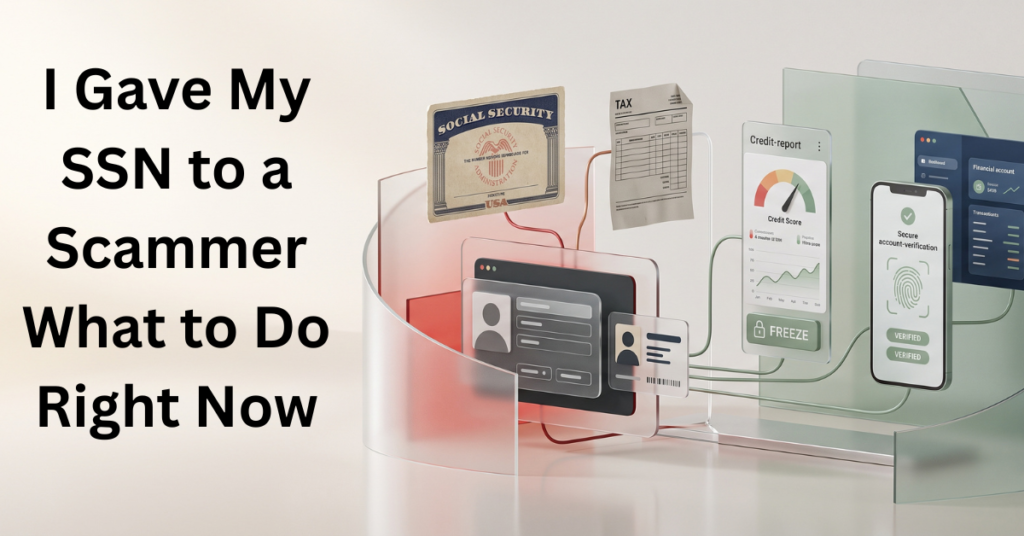
You can’t cancel a Social Security number like you can a stolen credit card. There’s no “request a new one” button, and the agency that issues them only reassigns a number in limited situations. So after giving your SSN to a scammer, the goal isn’t to replace it. It’s making it less useful to whoever has it.
That’s also why speed and order matter more than perfection. Some of what follows takes minutes, and a few steps are more urgent than others. If you shared more than your SSN, such as a card number, a bank login, or a one-time code, start there, because a live account can be drained far faster than a stolen SSN can be misused.
Imposter scams are the most reported fraud category the FTC tracks, accounting for close to a third of fraud reports and billions of dollars in losses in recent data, so you are far from alone. This guide walks through exactly what to do, in order, and what each step does and doesn’t protect.
The short version:
- Lock down anything with money or a login that you also shared.
- Freeze your credit at all three bureaus.
- Create your own my Social Security account, and block electronic access if the scammer has your number.
- Get an IRS Identity Protection PIN.
- Report it to the FTC and to the Social Security Administration’s Inspector General if the scam involved SSA or your benefits.
- Monitor your credit and your Social Security earnings record.
Table of Contents
First, List Exactly What You Shared
Before anything else, write down everything the scammer received. Your priorities depend on it.
| What you shared | How urgent | First move |
| SSN only | High, but slower-moving | Credit freeze, SSA account, IP PIN |
| SSN plus date of birth or full name | High | Same as above. Treat as full identity exposure |
| A card number | Immediate | Call the issuer, cancel the card |
| Bank login, password, or one-time code | Most urgent | Change the password, call your bank, secure the email tied to it |
| A photo of your driver’s license or passport | High | Add to the steps above, then report it to the FTC |
| An EIN or W-9 (freelancers) | High | See the freelancer section below |
This is IdentityBastion’s practical triage guide, not an official classification. It rests on one idea: money and logins can be lost in minutes, while a stolen SSN usually causes slower damage like new accounts and fraudulent tax returns.
An SSN alone is less useful to a thief than an SSN plus your name and date of birth, but don’t count on that protection. Names and birthdates are often easy to find, so treat any SSN exposure as serious. That reflects the top tier of our Exposure Framework.
The Steps to Take if I Gave My SSN to a Scammer
Step 1: Secure any live accounts you also exposed. Change passwords starting with your email, since it’s usually the recovery path for everything else. Call your bank or card issuer about anything you shared. Turn on app-based MFA if you haven’t.
Step 2: Freeze your credit at all three bureaus. A freeze makes it harder for someone to open new credit accounts in your name, and it’s free. If you’re not sure what the scammer got, a fraud alert is a lighter option, but when your SSN is involved, a freeze is the stronger choice. You must do it separately with Equifax, Experian, and TransUnion. [How to Freeze Credit as a Freelancer]
Step 3: Create your own my Social Security account. If you don’t have one, set it up before a fraudster does. Then consider asking SSA to block electronic access to your record. You can request this by calling SSA’s national line at 1-800-772-1213, and once it’s in place, no one, including you, can view or change your information through SSA’s website or automated phone service. You can request removal later after proving your identity. Confirm the current process on ssa.gov before you call.
Step 4: Get an IRS Identity Protection PIN. A thief with your SSN can file a tax return in your name before you do, and untangling that process takes a long time. An IP PIN helps prevent someone from filing a fraudulent federal tax return using your SSN. [Tax Identity Theft Risks for Self-Employed]
Step 5: Report it. File with the FTC at ReportFraud.ftc.gov. If someone has used your information, also file at IdentityTheft.gov to generate a recovery plan and an official report creditors often request.
If the scam involved someone pretending to be SSA, or you think someone is using your number for work or benefits, report to the SSA Office of the Inspector General at oig.ssa.gov. A police report isn’t universally required, but some agencies or creditors may request one depending on the case. Follow the requirements for the specific incident.
Step 6: Consider E-Verify’s Self Lock. If you create a myE-Verify account, you can lock your SSN so employers can’t use it in E-Verify employment checks. It helps against employment fraud, but only with employers who use E-Verify, so don’t treat it as a full block.
Step 7: Monitor. Check your credit reports with the free weekly access at AnnualCreditReport.com, and check your Social Security earnings record for wages from employers you’ve never worked for. [How to Monitor Credit Without Paid Tools]
Why You Probably Can’t Just Get a New SSN
People often ask whether they can be issued a new number. SSA assigns a new SSN only in limited circumstances, and a new number doesn’t automatically fix things because credit and tax records tied to the old one can create their own problems. That’s why the strategy is to protect the number you have: freeze what it can open, block what it can access, and watch for misuse.
If You’re a Freelancer Who Shared It With a Fake Client
Fake onboarding and W-9 requests are a common way freelancers lose an SSN or EIN. The steps above all apply. Add three things:
- If you gave your EIN instead of your SSN, the process differs. Business identity theft goes through IRS Form 14039-B, and you can’t freeze business credit like personal credit. [SSN vs EIN Risks for Freelancers]
- Check your IRS records for income you never earned, since freelancers face fraudulent 1099 reporting that employees don’t.
- Review how it happened, so the next fake request doesn’t work.[Identity Theft Risks of Sharing W9 Forms]
What Each Step Solves, and What It Doesn’t
| Step | Solves | Doesn’t solve |
| Securing accounts | Account takeover and drained money | Misuse of your SSN elsewhere |
| Credit freeze | New-account credit fraud | Tax fraud, existing-account fraud, and loan programs that don’t check credit |
| SSA electronic block | Someone viewing or changing your SSA record online | Credit fraud or tax fraud |
| IRS IP PIN | Fraudulent federal tax returns | Credit fraud and employment fraud |
| E-Verify Self Lock | Misuse of your SSN in E-Verify employment checks | Employers who don’t use E-Verify |
| Reporting to the FTC | Creates documentation for disputes | Doesn’t stop misuse by itself |
| Monitoring | Faster detection | Prevents nothing on its own |
Common Mistakes
Waiting for proof something was misused. You can’t un-share an SSN, and a freeze costs nothing. Acting early is cheap.
Freezing one bureau. A lender can still check the other two and approve credit in your name.
Skipping the SSA step. Creating your own account closes the door on someone else doing it first.
Treating the scam as over. Anyone who’s been scammed once can be targeted again, including by “recovery” services that charge fees to undo the damage. Real help from the FTC and IRS is free.
Forgetting to secure logins first. A shared password or one-time code is more urgent than a shared SSN.
FAQs: I Gave My SSN to a Scammer
Can Someone Use My SSN With Just the Number?
It’s less useful on its own than with your name and date of birth, but it’s still risky because those details are often easy to find. Take the steps above regardless.
Should I Freeze My Credit or Place a Fraud Alert?
If you know your SSN was involved, a freeze is the stronger option. A fraud alert is a lighter step when you’re unsure what was shared.
Can I Get a New Social Security Number?
Only in limited circumstances, and a new number doesn’t automatically solve the problem. The usual approach is to protect the number you have.
Do I Need a Police Report?
Not always. File with the FTC first, and file a police report if a creditor or agency requires one.
What if I’m a Freelancer and Gave My EIN Instead?
EIN misuse follows a different process, including Form 14039-B for business identity theft, and you can’t freeze business credit the way you can freeze personal credit.
The Bottom Line: I Gave My SSN to a Scammer
You can’t cancel a Social Security number, so the work is containing it: secure whatever else you shared, freeze your credit, lock down your SSA access, get an IRS PIN, and report it. Do these steps in that order, and don’t wait for something to go wrong, since most of this is free and quick.
What to Do Next
If you want to check whether anything has already been misused, our guide walks through where to look and how to read what you find.