
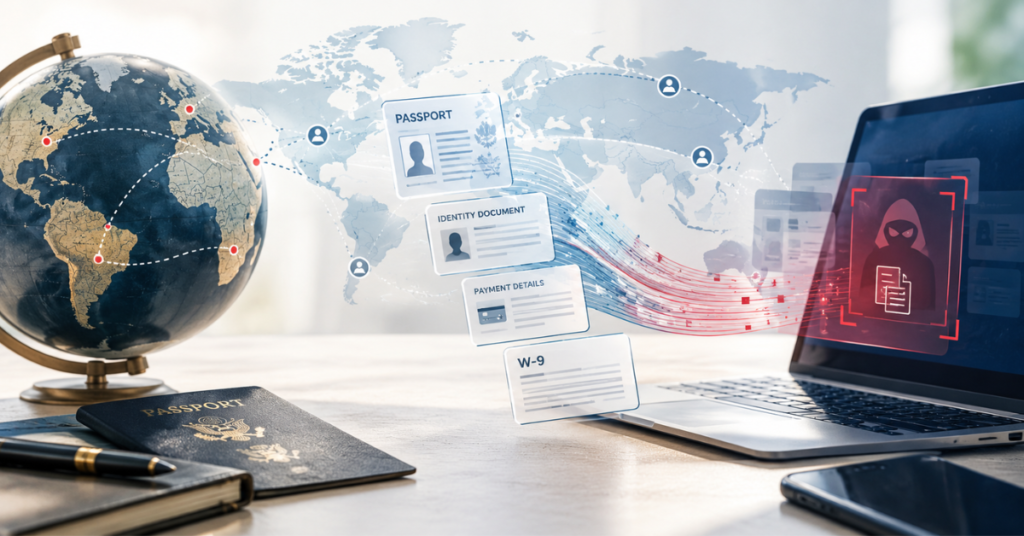
According to TransUnion’s 2025 global fraud research, U.S. businesses reported losing an average of 9.8% of their equivalent revenue to fraud over the previous year, compared with 7.7% globally (TransUnion). For freelancers, working across borders can add another layer of complexity because payment, identity verification, privacy, and dispute processes may involve multiple jurisdictions.
Working with international clients isn’t inherently more dangerous than domestic freelance work, but it does introduce specific risks that don’t apply within a single country’s legal and financial system. This article covers what actually changes, and where freelancers most often let their guard down simply because the transaction looks and feels different from a domestic one.
Table of Contents
What’s Genuinely Different About Overseas Client Relationships
Three things change the moment a client relationship crosses a border. First, payment often routes through international transfer or currency-exchange platforms that have their own, sometimes more extensive, identity verification requirements.
Second, the privacy laws protecting your data once you’ve shared it may be dramatically different, or in some cases, effectively nonexistent, depending on where the client or platform is based. Privacy protections can also vary by jurisdiction, and some cross-border data transfers are subject to specific legal safeguards rather than a single universal privacy regime (EU).
Third, If something goes wrong, pursuing a dispute can become more complicated when the other party and relevant records are located in another country. The FTC does cooperate with foreign authorities on cross-border consumer-protection matters, so international disputes aren’t necessarily outside U.S. enforcement reach.
None of that means avoid overseas clients. It means the caution that works fine domestically needs a few adjustments.
Legitimate KYC Request vs Scam Document Request
This is the distinction that causes the most confusion, and it’s worth drawing precisely: Payment platforms may have legal identity-verification and anti-money-laundering obligations (FATF). A private client does not automatically have the same regulatory role simply because you’re working together. Your client is not.
| Questions | Legitimate KYC (Payment Platform) | Red Flag (Client Directly) |
| Who’s asking | The payment platform itself (Wise, Payoneer, or similar), through its own verified onboarding flow | The client, via email or chat, asking you to send documents to them directly |
| What’s requested | Passport or government ID, proof of address, standard for anti-money-laundering compliance | The same documents, but routed through an unofficial channel outside the platform |
| Why it’s happening | Legal requirement the platform must meet regardless of who you’re working with | No legal basis, a legitimate client has no reason to personally collect your passport |
| Where it should happen | Inside the platform’s own app or website, over an encrypted connection | Anywhere else, email, chat, a shared document link |
This is IdentityBastion’s practical filter for cross-border verification requests, not a formal legal standard, but a fast way to separate a normal compliance step from a red flag. If a client is asking you to send identification documents directly to them rather than through your payment platform’s own verification system, that’s worth treating with the same suspicion as any other unsolicited request for sensitive documents. [Identity Theft Risks of Sharing W-9 Forms]
Why a Passport Scan Is a Bigger Deal Than an SSN
Per the IdentityBastion Exposure Framework, a passport sits alongside, arguably above, an SSN in terms of exposure risk. It’s a single document that combines your full legal name, date of birth, nationality, a photograph, and a government-issued number, all in one place, and it’s recognized as valid identification well beyond just U.S. financial and government systems. Where an SSN is primarily useful within U.S. systems, a compromised passport scan can potentially be misused in identity verification processes in multiple countries, which is part of why legitimate payment platforms handle this document through more secure channels than a typical client email would ever require.
The Vectors Specific to Cross-Border Work
Currency and invoice confusion scams. The overpayment scam covered in our general fraud vs. identity theft guide gets an added layer of cover internationally, currency conversion math is genuinely harder to check at a glance, and a scammer relying on this specifically counts on the exchange rate confusion buying them more time before you notice the numbers don’t actually work out.
Payment platform KYC concentrating your Tier 1 documents in one place. Legitimate international payment platforms may require government-issued identification as part of customer verification and regulatory compliance. For example, Wise says customers may need to provide a government-issued ID through its verification process (Wise). This is a necessary, legal process, but it does mean your most sensitive documents end up concentrated with a third party you’re trusting to secure them well, which is worth factoring into which platform you choose.
Weaker legal recourse if something goes wrong. If a domestic client scams you, you have options, small claims court, a police report, an FTC complaint. Once the other party is operating from a different country, most of those remedies either don’t apply or become dramatically harder to pursue, since enforcement cooperation between countries varies enormously and isn’t guaranteed for a dispute over a few thousand dollars.
Mismatched privacy protections. Data you share with a foreign client or platform may be governed by that country’s privacy law rather than anything resembling U.S. protections. Privacy protections depend on the jurisdiction and the circumstances in which your information is processed. For example, the GDPR establishes requirements for processing personal data and includes specific rules governing certain transfers of personal data outside the European Economic Area.
What Actually Helps, and What It Doesn’t
| Protection | Solves | Doesn’t Solve |
| Only providing ID/passport through the payment platform’s official verification flow, never directly to a client | Prevents your most sensitive document from being collected by an unverified party | Doesn’t protect you if the platform itself is later breached |
| Using an EIN rather than SSN on international paperwork where accepted | Reduces which identifier is exposed to foreign parties | Doesn’t apply to passport-based KYC, which requires personal identification regardless |
| Choosing established, regulated payment platforms over unfamiliar ones | Better security infrastructure and dispute processes than a smaller, unregulated service | Doesn’t eliminate cross-border enforcement gaps if a dispute needs legal follow-through |
| Verifying a new client via video call | Adds a real verification layer beyond email alone | Somewhat weaker than it used to be, given advances in deepfake and synthetic document generation |
| Getting payment terms and milestones in writing before starting work | Gives you a paper trail if a dispute needs to be pursued | Doesn’t guarantee enforceability across borders |
Common Mistakes With Overseas Client Work
Sending a passport or ID scan directly to a client because they asked for it. Don’t assume a client needs your passport simply because they request it. Ask why it’s required, who will store it, how it will be transmitted, and whether the information can instead be provided through an established verification process.
Assuming the same verification steps that work domestically translate directly overseas. Checking a company’s website or LinkedIn presence is still worth doing, but weaker corporate transparency norms in some countries make this kind of check less reliable than it is for a U.S.-based company.
Not accounting for currency conversion when checking a payment amount. An invoice discrepancy that would be obvious in a single currency can slip by when converted amounts are involved, which is exactly the confusion some overpayment scams are built around.
Assuming U.S. consumer protections apply by default. U.S. laws can provide important rights, but which protections apply depends on the transaction, parties, contracts, and jurisdictions involved. For example, the FCRA provides specific rights concerning U.S. consumer reports, while the FTC also works with foreign authorities on cross-border fraud.
FAQs: Risks When Working With Overseas Clients
Is It Normal for an Overseas Client to Ask for My Passport?
Not directly. Your payment platform may legitimately need it for compliance purposes, verified through its own official process, a client personally requesting your passport is a red flag, not standard practice.
Are International Payment Platforms Safe to Use for Freelance Work?
Generally, yes, if they’re established and regulated, the identity verification they require is a legal compliance step, not a sign of unusual risk. The key is making sure any sensitive document goes through the platform’s own system, not a client’s personal request.
What Happens if an Overseas Client Scams Me, Do I Have Any Recourse?
Cross-border disputes can be more complicated because the parties and relevant legal systems may be in different countries. Your available options depend on the transaction and jurisdictions involved. For international scams, the FTC directs consumers to econsumer.gov, and international authorities use those complaints to help investigate cross-border fraud.
Does GDPR Protect My Data if I Work With a European Client?
It can, but not simply because your client is located in Europe. GDPR applicability depends on factors such as where the organization is established and what personal-data processing is taking place. The European Commission also provides specific rules for certain transfers of personal data outside the EEA.
Should I Avoid International Clients Because of These Risks?
Not necessarily, international work is a normal and often valuable part of freelancing. The adjustments are about being more selective with verification and payment channels, not avoiding the work itself.
Bottom Line: Identity Theft Risks When Working With Overseas Clients
Cross-border freelance work doesn’t require a different mindset so much as a few specific adjustments to the caution you’d already apply domestically. The two changes that matter most: route any identity document through your payment platform’s own official verification process rather than sending it directly to a client, and go in knowing that if something does go wrong, your usual U.S.-based recovery options may not reach the other party the way they would if the client were down the street instead of overseas.
What to Do Next
Payment platforms come up constantly in cross-border work, they’re the ones actually requesting your sensitive documents, and their own security practices matter as much as anything a client does. Our guide covers what to actually look for.
Pingback: How Identity Theft Happens During Client Onboarding in 2026